Here are the links and tools that caught my attention in July.
Most of what I saved in July centered on coding agents after Fable came back: setup notes, usage patterns, loops that keep sessions moving, and the review constraints people add once agents outrun human reviewers. A second cluster covered Hermes coordination and marketing skill stacks. The rest is bookmarks.
Fable setups, unknowns, and routing
Claude Fable 5 returned on July 1. A lot of the month’s saves were about how to set it up and how to use it without lighting money on fire. In practice, I’m mostly using GPT-5.6 Sol.
Siqi Chen (product builder and investor; previously Runway, Sandbox VR, and Zynga) posted a favorite frontier-model eval prompt and said Fable “destroys it.” The prompt:
Draw the most surprising connection between well known concepts that nobody has ever connected before in order to discover a detailed, highly plausible, valuable, and falsifiable novel scientific theory that nobody has ever discovered before. Avoid bio and AI domains.
Replies still produced concrete shapes: “Celestial Band Theory” (electron bands meets orbital resonances, with a predicted -1/2 pileup exponent and Kepler/TESS tests), “plate tectonics is grain coarsening,” a volcanic electrostatic placer idea, and a Talbot-effect story for periodic seabeds.
A Field Guide to Fable: Finding Your Unknowns from Thariq on Anthropic’s Claude Code team argues that Fable work quality bottlenecks on unknowns: the gap between prompts, skills, and context on one side and the real codebase and constraints on the other. Before you build, run blind-spot passes and one-question interviews. During and after, keep plans that lead with changeable decisions, log implementation notes when the plan drifts, and quiz the change before merge. The line worth keeping: “reducing and planning for your unknowns is the skill.”
David Zhang (founder of DuetChat, former NASA JPL engineer) fed that kind of article to Fable and built an explore-unknowns skill that scans a repo, interviews you one question at a time, then sweeps for unknown unknowns.
How To Use Claude Fable 5 Without Going Bankrupt frames Fable 5 as very capable and expensive, said to cost about twice Opus 4.8 and to burn tokens on casual use. Prices and savings figures are the author’s. The control I’d actually steal is a CLAUDE.md routing table: Fable on early planning and late review, cheaper models on the middle stretch, plus handoffs, effort defaults, and spend caps so Fable orchestrates instead of doing grunt work. Theo Browne (CEO of t3.chat; developer and YouTuber) posted the CLAUDE.md section he vibed out for the same shape. He still prefers Codex for computer use, UI/UX verification, and well-specified execution, and says his discard rate on end-to-end agent PRs went from about half to none on the day he describes.
Model launches usually hand you benchmark tables. What I want is the same prompt run side by side so the differences are visible. TryAI’s one-shot build-off gave Grok 4.5, GPT-5.5, Claude Opus 4.8, and Claude Fable 5 identical prompts for single-file HTML apps: a 3D Rubik’s Cube, a gravity sandbox, and Breakout. Per the post, Opus and Fable tied on their first attempts at the cube. All four shipped working sandboxes and playable versions of Breakout. Their harness table had Grok fastest and cheapest, and Fable slowest and priciest.
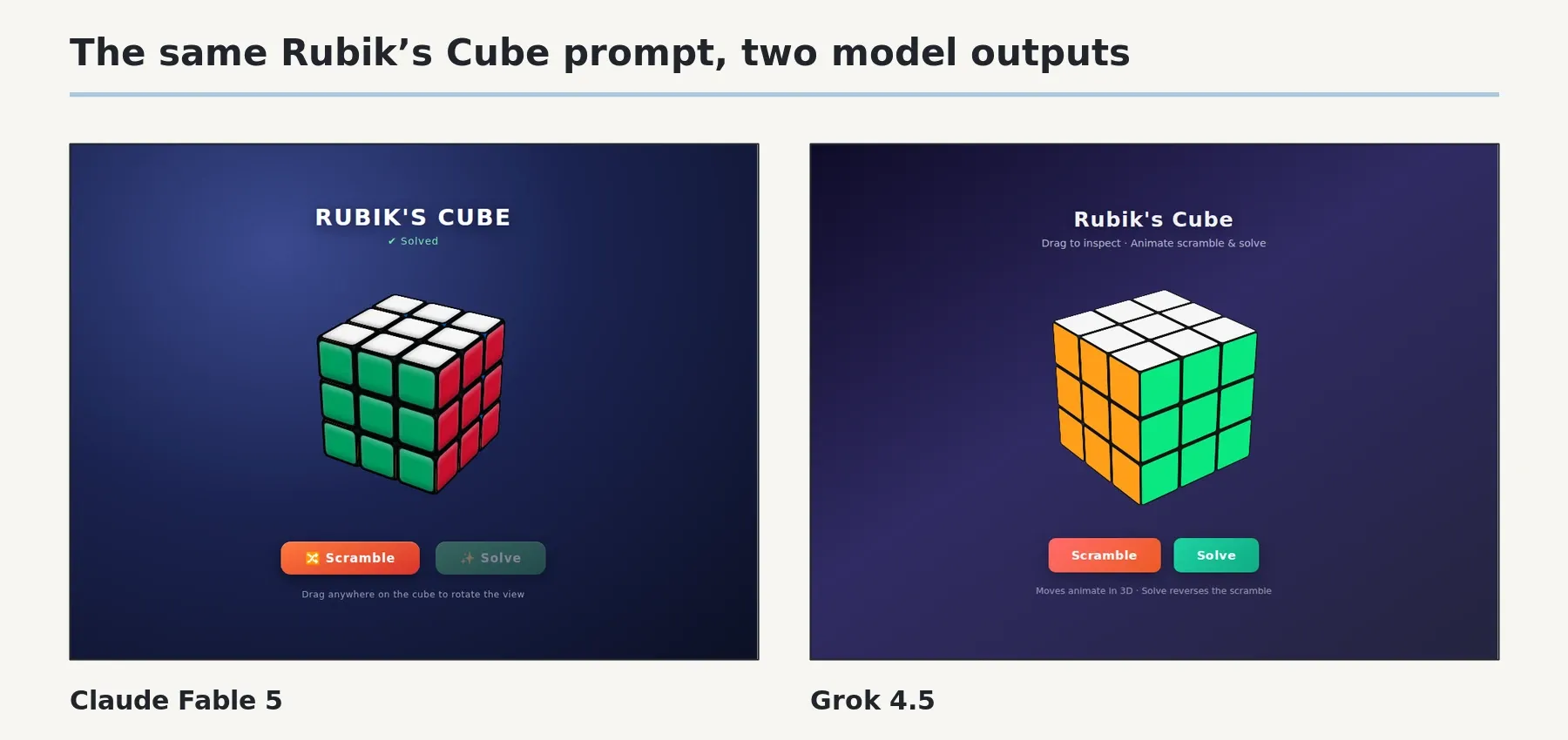
Fable 5 (left) vs Grok 4.5 (right) on TryAI’s identical Rubik’s Cube prompt. Source: TryAI build-off.
Loops, runtimes, and less bloat
Paul Solt builds iOS and macOS apps with Codex. His workflow is three plain pieces:
- Manager thread: one thread owns the others, so a single place decides what runs next
- Heartbeats: repeat an action or check-in on a cadence
- Goal: put
/goalon work threads so agents keep going until the assigned work is actually done
Combined, those cover scheduling, PR issue handling via a code-review plugin, and pushing work until it is merge-ready. The part I care about is naming who manages whom instead of hoping one thread remembers the whole job.
The Claude Code team’s Getting started with loops defines loops as agents repeating cycles of work until a stop condition is met. It covers turn-based loops, goal-based loops via /goal with verifiable exit criteria and turn caps, time-based /loop and cloud /schedule, and proactive routines composed with skills and auto mode. For tokens and quality, it recommends a clean repo, verification skills, second-agent review, clear stop conditions, and scripts for deterministic steps. Start with the simplest version that closes.
Herdr is a background runtime for coding-agent terminals on macOS and Linux (Windows beta). Sessions keep running when the client disconnects, layouts restore after restart, and a sidebar marks agents working, blocked, or idle. It owns the terminals for existing CLIs rather than replacing them.
Matt Pocock (developer educator; Total TypeScript and AI Hero) posted a short path to cut Claude Code system-prompt bloat: proxy the traffic, see the cruft, apply his settings.json, and start sessions around a clean 13K tokens. He also posted about kicking off /wayfinder with an extremely ambitious idea. That second post is enthusiasm about the session, not a setup guide.
Smallest useful loop from this section: one manager, one heartbeat, one /goal with a stop condition you can check without reading the whole transcript.
Review less, constrain more
When agents write faster than people review, the bottleneck moves. At Hello Gravel we rolled out an internal agent called Merge Boy in July to review and merge PRs so people do not have to babysit them. I want a separate Merge Boy writeup. Until then, PostHog’s Stop being the code review bottleneck is the external process I want to borrow from.
They describe multi-agent review swarms that separate author from reviewers, loops that babysit CI and flaky tests, an auto-approver (“StampHog”) for low-risk PRs after deterministic checks, and verification by running small stacked PRs rather than trusting agent explanations. For the StampHog-style path specifically, they report roughly a third of final stamps and about 1.6K PRs handled in a month in their setup. The lines that stick: “review as little code as possible” and “observability over reasoning.”
Parts of PostHog’s process worth stealing for Merge Boy
- Separate author and reviewer agents
- Deterministic checks before auto-approval
- Escalation for risky or ambiguous changes
- CI and flaky-test babysitting
- Screenshots or observed behavior for frontend verification
Uncle Bob Martin (software author and longtime programmer) describes his strategy as not reading any of the code his agents write. He says he surrounds them with unit tests, Gherkin tests, QA procedures, quality metrics, mutation testing, and coverage, and takes confidence from the gauntlet rather than from reading the diff.
PostHog wants humans outside the default review loop. Uncle Bob wants extreme constraints and no reading of the agent diff. Same bottleneck, two hard versions of the answer.
Hermes coordination and marketing skills
Next to the coding-agent pile sat Hermes operator notes and marketing stacks that treat distribution like agent ops.
Hermes Agent Master Class Part 10 from Tony Simons (consultant who helps people set up Nous Research’s Hermes Agent) treats Kanban as shared multi-agent state rather than a personal todo board. Hermes keeps a durable SQLite board under ~/.hermes/kanban/ that multiple profiles can read, claim, and advance through todo, in progress, review, and done, with blockers, deadlines, and lifecycle notes. The board is the coordination layer so orchestrator, worker, and reviewer profiles do not need a private chat thread to stay aligned.
Tony also shipped interview-me in the Hermes Field Kit. The skill checks files and notes first, asks one high-value question at a time, stops when another answer would not change the next move, emits a decision brief, and writes nothing to memory without approval. Same unknowns habit as the Fable field guide, packaged as a pre-project gate.
Stop Fixing Hermes. Start Using It. from Axl Ibiza (Hermes Agent developer at Nous Research) is the counterweight. One operator replaced external memory, local patches, and an AGENTS.md over 23k characters with documented defaults and a shorter rules file, then reported fewer repeated corrections and faster failure-pattern search in session history. Default Hermes beat the custom stack.
On the marketing side, Eric Siu (founder working on Singlebrain and the Single Grain ad agency) open-sourced marketing and sales skills he says were built on real pipelines. In a follow-up prompt, he tells you to hand a skills repo to an agent, map each skill to weekly work, flag hand work a skill already covers, find the high-leverage gaps, and chain the three highest-leverage skills into one command. That audit-and-chain move is more useful than another “comment HERMES for the guide” pitch.
Alex Lieberman (Morning Brew cofounder; founder of Tenex Labs) described Tenex Labs’ Content Machine, a multi-step system a two-person marketing team uses to turn existing human speech and writing into multi-format posts through mined sources, research, creator interviews, multi-persona review, and repurposing. His key ingredient: “the raw material must come from you.”
Company AI field reports
Sierra’s AI-pilling our company is the company-scale field report with the clearest receipts. They collapsed role-specific agents into one company-wide agent, Pinecone, after cross-team work broke the persona model. Their line: “Business context is the bottleneck, not intelligence.” They broker tools through an MCP Gateway that inherits employee access, keep GitHub and similar systems as systems of record, and report more than 75,000 sessions across roughly 600 people, with about 70 percent of PRs opened through the agent, while still saying outcome measurement is weak. The companion Pinecone writeup from Allen Chen (engineer at Sierra) is about getting useful agent work off individual laptops into shared cloud sessions, skills, and PR babysitting.
Claire Vo (founder of ChatPRD; three-time CPO/CTO) posted a supporting build list for executives learning AI by doing: morning briefing, afternoon todo, custom email client, meeting-notes processor, exec coach, podcast of everything you missed in Slack, board memo as HTML, and more, ending with “just start.”
The company move worth copying is one shared agent with real systems access, concrete session and PR numbers, and honest outcome metrics still to build.
Stuff I bookmarked
- AI video and ad tools I parked for later: FLORA, Veo 3.1, Kling, CapCut, Descript, HeyGen, Arcads, Creatify, Foreplay, and Motion. Generators and avatars on one pass; swipe files and creative reporting on another.
- Last30Days v3.11: the release claims one-command agentic search across X, Reddit, YouTube, TikTok, Instagram, arXiv, Techmeme, HN, Digg, and Polymarket. Coverage list and ~51K star figure are the post’s claims.
- Stagehand and Browserbase: browser-agent SDK with natural-language act/observe/extract, plus search, fetch, and browser sessions underneath. Speed and usage figures on both sites are vendor claims.
- OmniRoute: free local gateway that puts many LLM providers behind one OpenAI-compatible
/v1endpoint, with auto-fallback claimed on the page. - Send to Kobo/Kindle: temporary key plus upload; the file appears on the e-reader while the key page stays open on Wi-Fi, then the server deletes it when the key expires.
- Alexandria: a loop where AIs read and update a living map of how you think in private files you own, meant to travel across tools instead of locking memory inside one product.
- Free Ink: open e-reader stack I saved under a DIY e-reader note. CrossPoint firmware, FreeInk SDK, and de-link hardware with published KiCad and BOM; the page claims a roughly $60 hand-solderable build.
- Readeck: personal web saver with labels, highlights, search, optional video transcripts, and ebook export of articles or collections.
- Uplifted, SoloKits, and Rishi Jain’s Claude Skills Library: large marketing and ops skill catalogs. Treat the performance claims as vendor copy.
- How to build an audience when you hate building a “personal brand”: creator partnerships, SEO/GEO, and niche media instead of becoming the brand.
- How To Actually Design With AI: keep taste human; use AI to execute.
- Ideas to help you build a better personal network: specific asks beat “pick your brain.”
- scroll-world: agent skill that interviews for brand and scenes, generates stills plus frame-locked dive/connector clips, then wires a vanilla-JS scroll-scrub landing page. Video backends cost money and are not shipped in the repo.
- Marble Curriculum: open primary-school knowledge graph claimed at 1,590 concepts and 3,221 links across eight subjects.
- Geogristle on ADS-STE100: bare claim that Simplified Technical English constraints cut LLM doc slop.
- HN thread on an STE agent skill: split between one-line STE prompts and Vale/hooks when models drift.
- Vox: stop banning em dashes and “delve” one phrase at a time; paste real writing rules into global CLAUDE.md or AGENTS.md.
- ayghri/i-have-adhd: public skill that forces action-first replies, short numbered steps, and no “hope this helps” closers. The public repo page showed roughly 19.6k stars.
- Samantha Trimble’s Codex prompt: reviews a day’s Slack, email, calendar, and computer activity, ranks automation opportunities, and returns three quick wins plus one larger project without making changes.