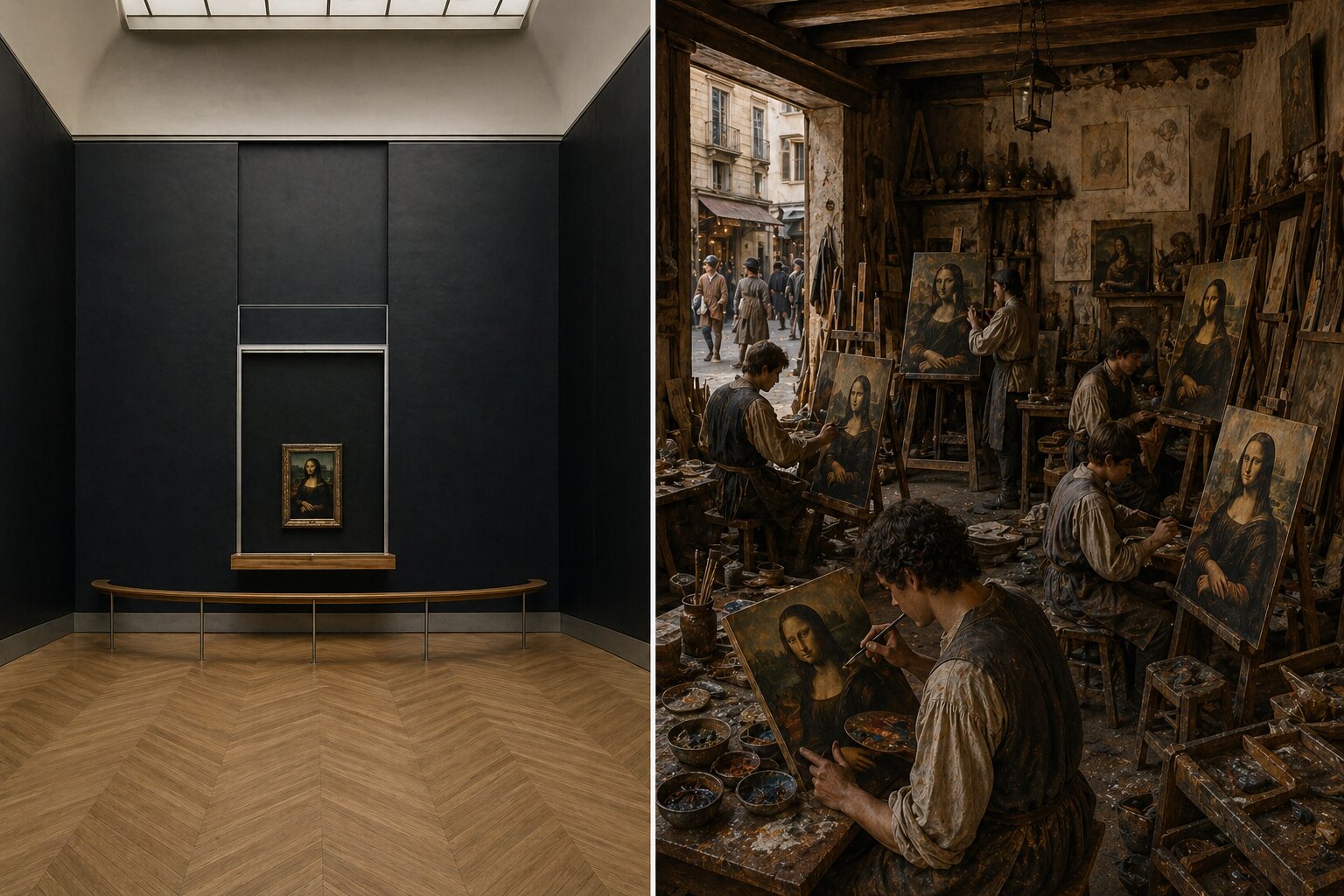
I read Walter Isaacson’s Leonardo book last year, and recently I’ve been thinking about the Renaissance in the context of our current AI era: slop, vibe coding, copycat apps, weird experiments, all of it.
Verrocchio’s workshop in Florence was not a museum. It was a shop. On the ground floor, open to the street, apprentices and artisans made paintings, sculptures, metalwork, pottery, and whatever else customers would buy. A lot of it was unsigned. A lot of it was collaborative. The goal was to keep work moving out the door.
Isaacson puts it plainly:
Verrocchio’s bottega, like those of his five or six main competitors in Florence, was more like a commercial shop, similar to the shops of the cobblers and jewelers along the street, than a refined art studio.
Leonardo came out of that shop. The Renaissance we remember is filtered through museums, textbooks, and a few hundred years of selection bias. The Renaissance people lived through had workshops, copies, apprentices, customers, derivative work, and mediocre output.
Even the Mona Lisa had copycats before Leonardo was finished with it.
The Madonna factory
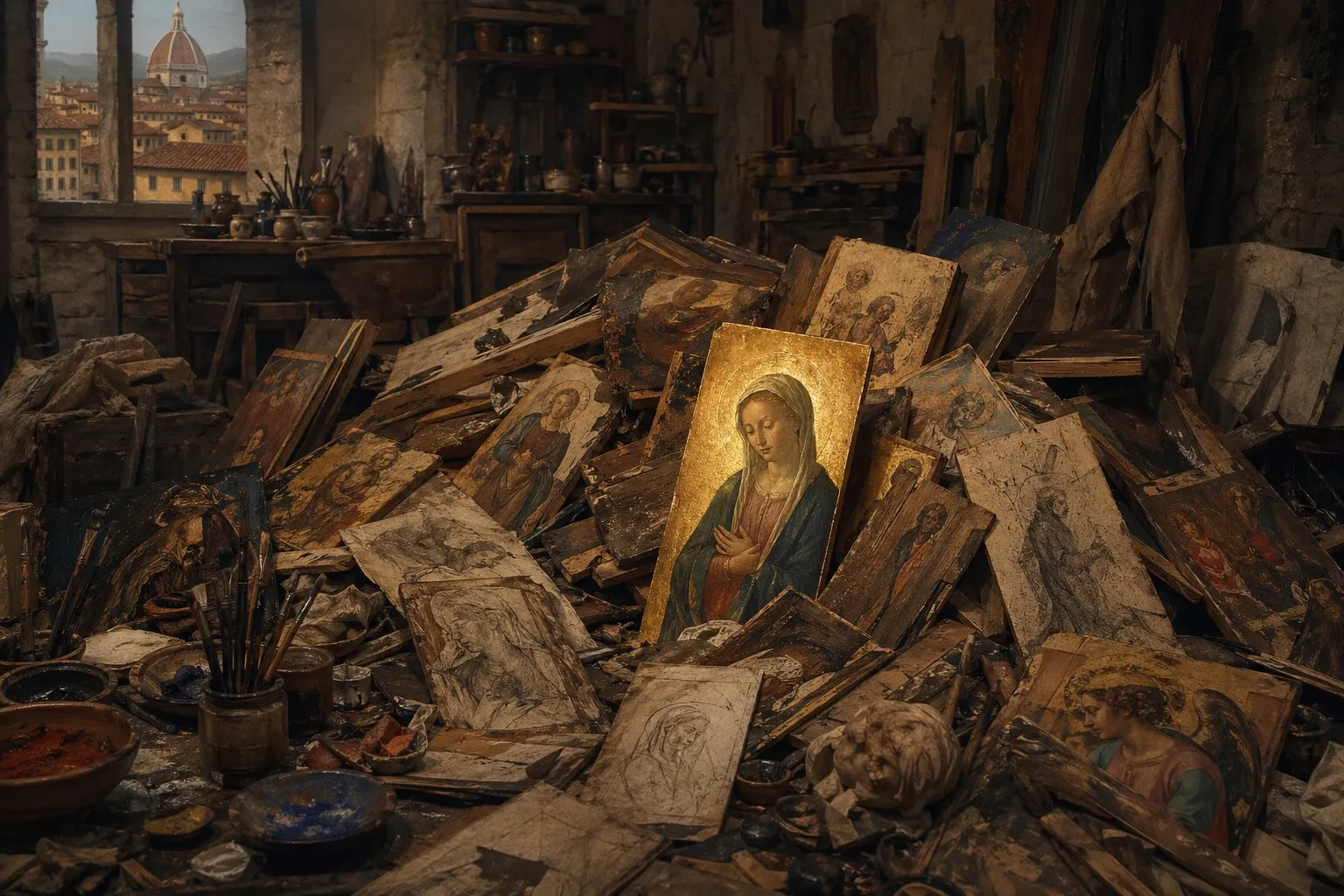
Isaacson describes Florence in the 1400s as an unusually good place to make things. Its economy “interwove art, technology, and commerce.” In 1472, the city had “eighty-four wood-carvers, eighty-three silk workers, thirty master painters, and forty-four goldsmiths and jewelry craftsmen.”
That sounds romantic now because it is Florence and it is five hundred years away. But at street level, it was commerce. The shops had orders to fill. They trained apprentices. They copied formulas because the formulas worked.
Verrocchio’s shop was part of that system. Isaacson writes that “the paintings and objects were not signed; they were not intended to be works of individual expression. Most were collaborative efforts.” The average thing coming out of the system was not a masterpiece. It was product.
The workshop still mattered. Leonardo was not discovered fully formed in a field and airlifted into history. He learned by watching, copying, mixing pigments, preparing panels, painting parts of larger works, and being around people who were making things all day.
His early work was not obviously Leonardo yet. Isaacson writes that, at twenty-four, Leonardo “was not only still living with his teacher but was producing Madonnas so lacking in distinctiveness that it is hard to tell whether they were painted by him or someone else in the workshop.”
That sentence is funny in the context of genius. The young Leonardo was making indistinct workshop Madonnas.
Somewhere in the pile of ordinary devotional output was a person who would eventually paint the Mona Lisa. You cannot separate the genius cleanly from the production environment that made him possible.
Copies everywhere
Copies were part of the Renaissance machine. New creative systems produce a lot of derivative output before anyone knows what is worth keeping. The Mona Lisa is the cleanest example. Isaacson writes:
Even as Leonardo was perfecting the Mona Lisa, his followers and some of his students were making copies, perhaps with an occasional helping hand from the master.
The original and the derivative work were being made in the same orbit while the canonical version was still changing. The museum version in our heads makes the Mona Lisa feel singular. The workshop version was messier.
The same problem shows up around Salvator Mundi, a painting of Christ as “Savior of the World” that some experts attribute to Leonardo and others still dispute. Isaacson notes that there were “at least twenty copies painted by some of Leonardo’s followers.”
The painting later sold as Leonardo’s Salvator Mundi had been damaged, overpainted, varnished, and misattributed. At one point, it was attributed to Leonardo’s student Boltraffio. Later it was catalogued as “a copy of Boltraffio’s copy.” When it sold at auction in 1958, Isaacson writes, “it fetched less than one hundred dollars.”
Set aside whether you think the attribution is right. The useful part is the confusion. A system that made copies, trained apprentices, reused compositions, and blurred workshop hands produced a pile so messy that, centuries later, experts were still trying to figure out what was original, what was derivative, and what mattered.
The filter comes later
Isaacson makes the broader comparison himself. The fifteenth century of Leonardo, Columbus, and Gutenberg, he writes, was “a time of invention, exploration, and the spread of knowledge by new technologies. In short, it was a time like our own.” (And Isaacson wrote this in 2017, before the current AI era!)
That is the AI and Renaissance comparison I buy. Not “AI image generators are like Leonardo.” The better comparison is the system around the work: new tools, more makers, more copying, more amateurs, more commerce, more junk, more experiments.
The interesting AI work I see is rarely someone pressing a button and accepting the first output. It is people using the tools inside a larger practice. The tool lowers the cost of trying things, copying things, remixing things, and throwing things away.
Most of what comes out will not matter. That was probably true in Florence too.
The Renaissance looks clean from a distance because history did the editing. It kept Leonardo and Michelangelo. It kept a few notebooks, paintings, frescoes, and the names of the people who became impossible to ignore. It did not keep every anonymous Madonna from a Florence workshop.
AI may produce nothing comparable. We may look back and decide this era produced spam, legal fights, autocomplete, and a few useful internal tools. But I’m a bit more optimistic. The slop is part of the process. The museum version comes later.