With 1:56 left in the national championship game for the 2003 season, Oklahoma was down by a touchdown and facing fourth-and-ten at its own 49-yard line. The Sooners still had Jason White, the Heisman Trophy winner from Tuttle, Oklahoma. His back was to me. I was in the LSU student section behind the end zone.
I can still vividly remember Lionel Turner coming straight through the middle and sacking White. The game was effectively over. We were going to win the national championship.
The game was in the Superdome in New Orleans, which made it feel like a home game. After LSU won, it felt like the entire stadium emptied into the French Quarter. I met up with friends who hadn’t had tickets, and we spent the night celebrating. The sun was coming up by the time I headed home.
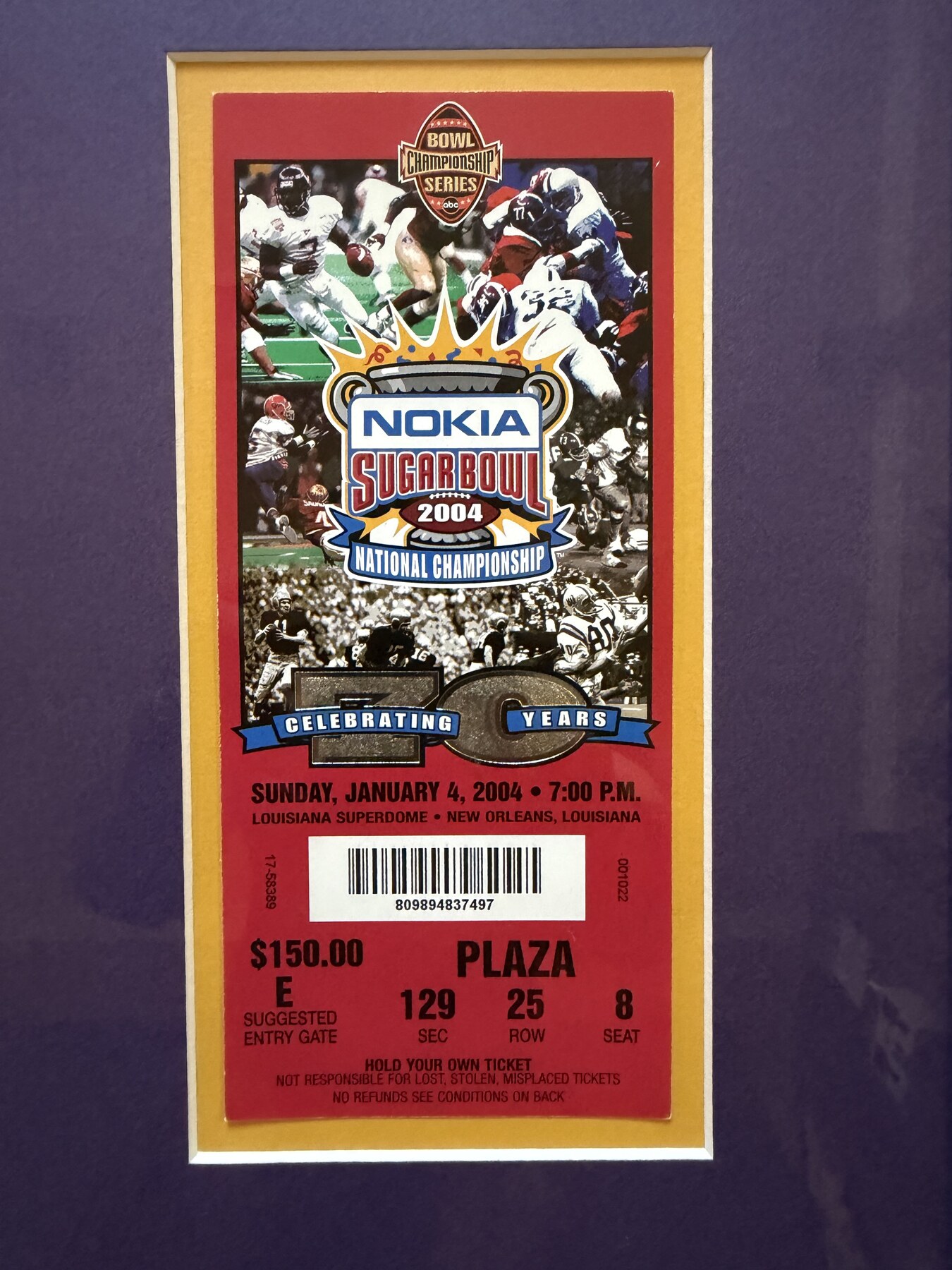
I framed my ticket from that game.
I was a sophomore at LSU that year. Being a student during a national championship run is about as much fun as you can have as a sports fan. But the players made it feel like something more specific than a great football team.
Turner was from Walker, just outside Baton Rouge.
My other vivid memory from that game is Marcus Spears returning an interception for a touchdown in the third quarter. Spears grew up in Baton Rouge. More than 20 years later, he’s on ESPN and you can still feel how much LSU means to him.
The team felt like Louisiana playing football against the rest of the country.
I know that was never completely true. The 2003 roster included plenty of players from other states, and college football has always had transfers. But it felt true enough. A large part of the team came from Louisiana, and most of the players arrived at LSU as young recruits and stayed there.
That continuity was a big part of what made college football different from the NFL. I don’t think I realized how much I valued it until it started disappearing.
The No. 5 problem
The thing that most recently brought this feeling back was the strange public dispute between LSU and Jayden Daniels over the No. 5 jersey.
Daniels grew up in California, then transferred to LSU from Arizona State in 2022. He was at LSU for two seasons. In the second one, he won the Heisman Trophy.
I love Jayden Daniels. When the Commanders played the Saints in New Orleans during his rookie season in December 2024, I brought my son because I wanted us to see him play. I’m a big Saints fan, but this was the LSU Heisman winner coming back to Louisiana. My son wore an LSU jersey. Plenty of other people did too.
Then LSU assigned No. 5 to DJ Pickett. Daniels’s representatives objected, and in August 2026 his attorney sent LSU a cease-and-desist over the school’s use of his name, image, and likeness. Daniels’s spokesperson connected the dispute to the jersey decision. LSU had not officially retired the number, and the accounts of what had been promised do not completely agree.
It just makes me sad.
Daniels is also a complication for the argument I’m making. He had no Louisiana roots that I know of and spent only two years at LSU. He was exactly the kind of transfer the new system makes possible. And LSU fans loved him enough to show up at a Saints game in purple and gold.
That connection was real, which is why seeing it turn into lawyers and a jersey dispute makes me sad.
What changed on LSU’s roster
I wanted to know if the roster had actually changed as much as it felt like it had, so I pulled every official LSU football roster from 1995 through 2026.
I tracked two simple things: whether LSU listed a Louisiana hometown and whether it listed a previous school. Previous school is an imperfect transfer proxy. It includes junior college players and the smaller number of transfers who existed before the portal. But it gives us one consistent field across 32 seasons.
The difference between the championship roster I remember and the current preseason roster is large.
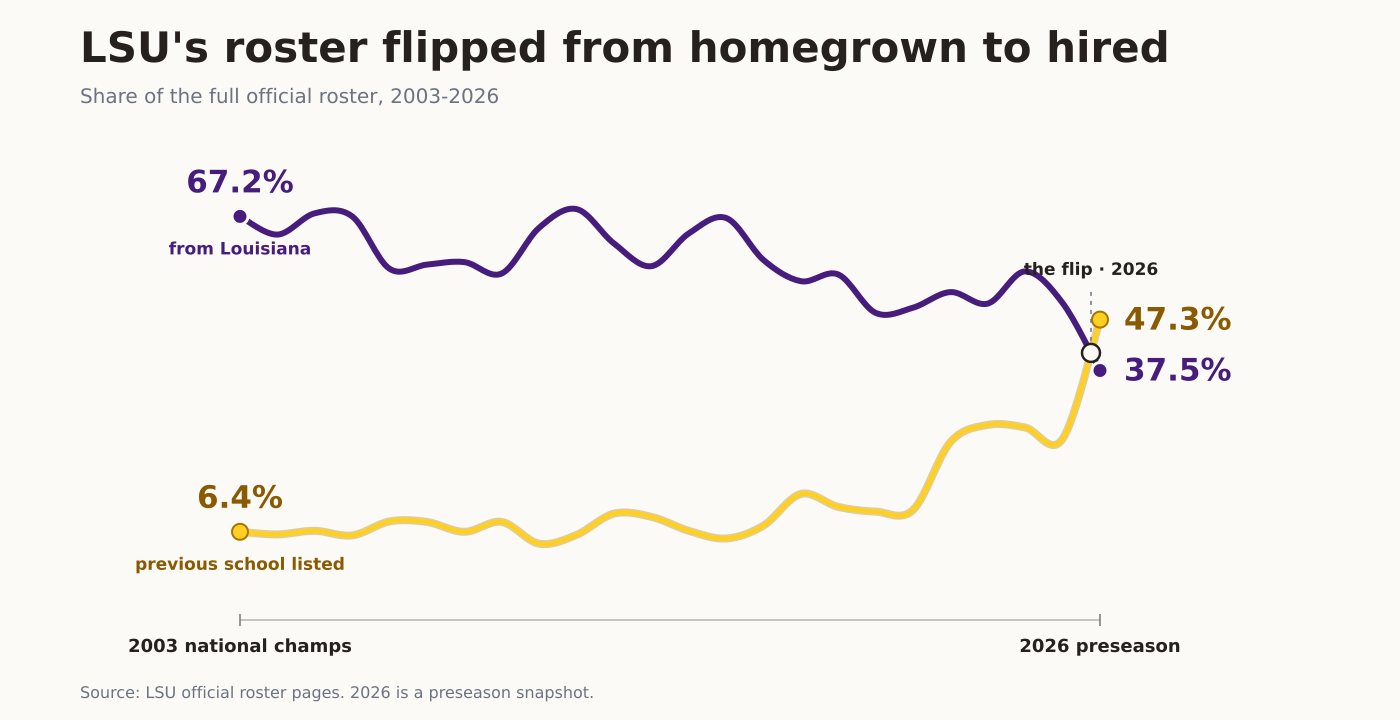
The 2003 roster had 84 Louisiana players out of 125. Only eight players had a previous school listed. In 2026, LSU lists 42 Louisiana players out of 112 and 53 players with a previous school. Forty-seven players, or 42.0% of the full roster, are both from outside Louisiana and listed with a previous school.
The current roster is majority out of state and not quite majority transfer.
The longer history matters because the portal didn’t start this trend.
LSU’s roster averaged 73.2% Louisiana hometowns from 1995 through 2004. That fell to 61.6% from 2005 through 2018, then 51.9% from 2021 through 2025. LSU had been recruiting a more national roster for a long time.
The portal changed a different part of the relationship. From 1995 through 2018, an average of 7.1% of the roster had a previous school listed. From 2021 through 2025, it was 22.4%. On the current preseason roster, it is 47.3%.
84 of 125 in 2003. 42 of 112 today.
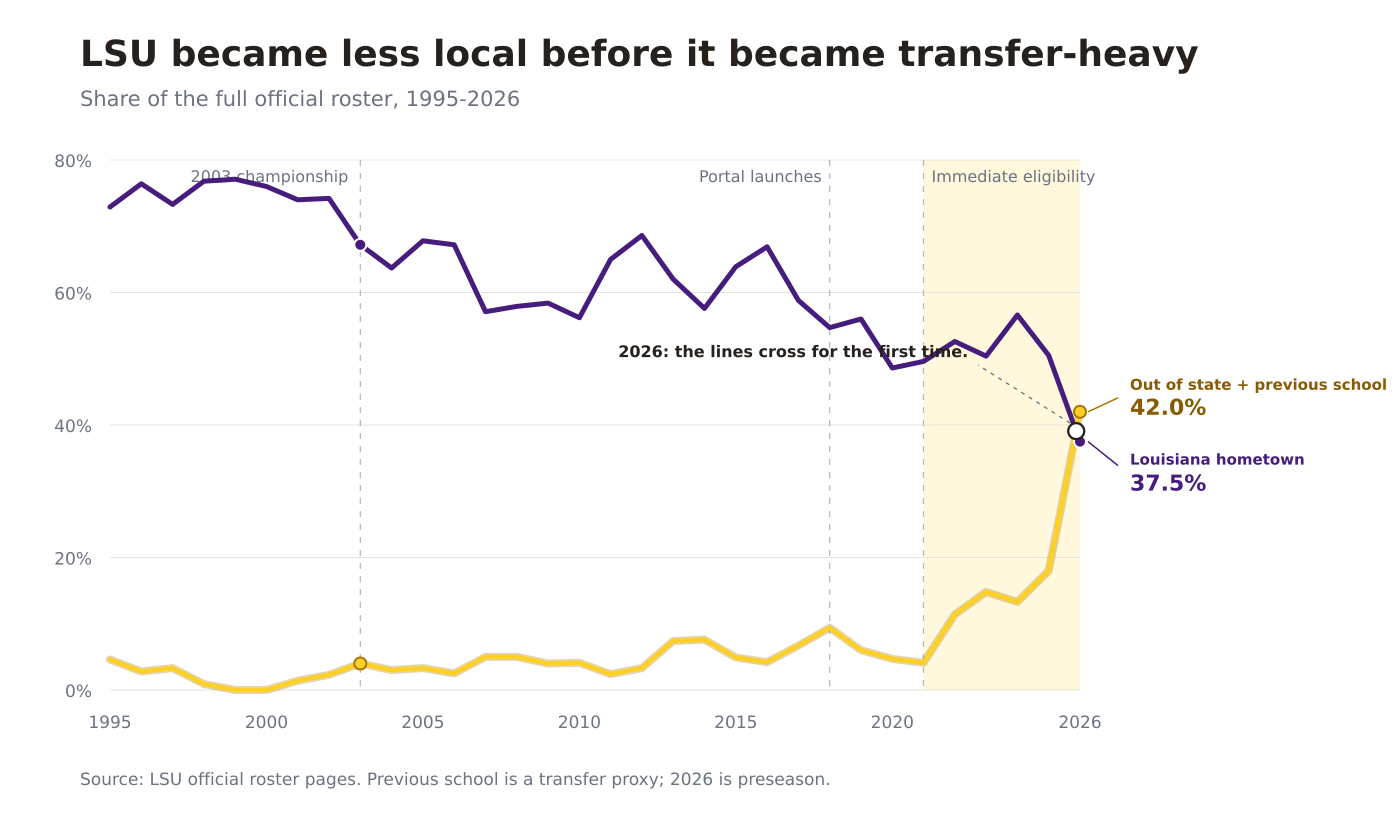
So there are really two changes. Fewer players are from Louisiana, and many more players began their college careers somewhere else.
This is bigger than LSU, but it isn’t the same everywhere
I ran a second analysis across 25 prominent college football programs.
The broader data tells the same story, with an important warning against making it too tidy.
First, recruiting became more national well before today’s transfer market. Across the 25 programs, the average share of high school signees from the program’s home state fell from 47.0% in 2002-2006 to 35.3% in 2021-2025. It declined at 20 of the 25 schools.
Then program continuity changed. Using recurring ESPN athlete IDs to detect whether a player had previously appeared at another school, the average transfer share rose from 2.6% in 2016-2018 to 13.7% in 2021-2025. It increased at all 25 programs.
I combined the two measures into a group I called the local-developed core: players born in the program’s home state who had not previously appeared on another college roster. That group declined at 18 of 25 programs.
There are limitations. The SportsDataverse roster data, documented by cfbfastR, uses birthplace state rather than high school or hometown. The athlete-ID method misses some transfers. Full rosters include walk-ons, and I did not weight players by snaps, starts, or production. This is a useful direction, not a perfect measure of fan connection.
The lines make the change clearer. Every program moved up because transfer reliance increased at all 25 programs. Many also moved left as the home-state share declined.
LSU moved from Homegrown into Local reload: still more place-rooted than the average prominent program, but now much more reliant on transfers. Clemson stayed in The academy, recruiting nationally while developing almost everyone in-house. Oklahoma moved from The academy into Free agency. Texas remained closest to Homegrown.
I still think tribalism is the right word for what I miss. But calling one group tribal and the other mercenary doesn’t hold up as a way to classify teams. There are at least two separate questions:
- Is the roster rooted in the school’s place?
- Did the program recruit and develop the players, or assemble the roster through transfers?
An out-of-state freshman who stays for four years may feel more connected to a program than an in-state player who arrives for one season. Jayden Daniels shows the reverse is possible too. A transfer can create an intense connection in two years.
But when both forms of continuity decline at once, the relationship gets harder to sustain.
The portal didn’t do all of this
The NCAA launched the transfer portal in October 2018. The bigger roster break came after the NCAA adopted a uniform one-time transfer exception in April 2021, allowing athletes in football and other sports to transfer once without sitting out a season. The interim NIL policy followed that June.
Those changes happened too close together for roster data to tell us that NIL caused any particular result. And I am not arguing for the old transfer rules. The old system gave coaches mobility that players did not have.
I don’t need to resolve the policy argument to notice that the new rules changed the experience of being a fan.
What I miss
As Nick Saban has said, you could shake a tree in Louisiana and skill guys would fall out.
That local talent was part of the fun. So was watching players grow up inside the program. You learned who they were, where they came from, and how they fit into the team. By the time they were juniors and seniors, they felt attached to LSU in a way that went beyond wearing the uniform for a season.
A transfer quarterback won LSU a Heisman Trophy and got me to bring my son to an NFL game wearing purple and gold.
But something is sanding me down. The NIL fights. The transfer portal. The coaching contracts. Even Lee Corso’s retirement from College GameDay felt like the final page turning on a version of the sport I loved.
I am not trying to convince players to stay where they don’t want to be, or arguing that LSU owns a permanent claim on Jayden Daniels because he won a Heisman there.
I just miss when rooting for LSU felt a little more like rooting for Louisiana, and a little less like rooting for whoever happened to be wearing the jersey that year.